The demo worked. The vendor showed a conversational agent that diagnosed order fallout, pulled the relevant CRM records, identified the root cause as a product catalog mismatch, and proposed a corrective action. The proof-of-concept ran for six weeks in a sandbox with synthetic test data. The business case showed a 60% reduction in manual fallout resolution time. The steering committee approved the production rollout.
Three days into production, the agent stopped working. The first fallout ticket it tried to process returned a session timeout. The second one came back with an HTTP 500 and a stack trace pointing to the product catalog API. The third one submitted a SOAP envelope that the order management system rejected as schema-invalid, and the order state for 140 customers had to be manually corrected over the following weekend.
The SI’s diagnosis: “The production environment has edge cases we did not encounter in sandbox.” The actual diagnosis: the agent was built to talk REST to systems that mostly speak SOAP, to query schemas that do not expose the semantics the agent needs, and to reason about state that is scattered across three systems with no shared definition. None of this surfaced in the demo because the demo did not touch the actual BSS boundary.
This is the pattern in every pilot-to-production attempt that stalls. The fear that AI will create havoc in production BSS environments is real, but the AI itself is rarely the cause. It is the boundary where the AI touches legacy systems that were never designed to be queried by anything fluent and autonomous. When that boundary is not architected deliberately, the agent dies on contact.
The five walls
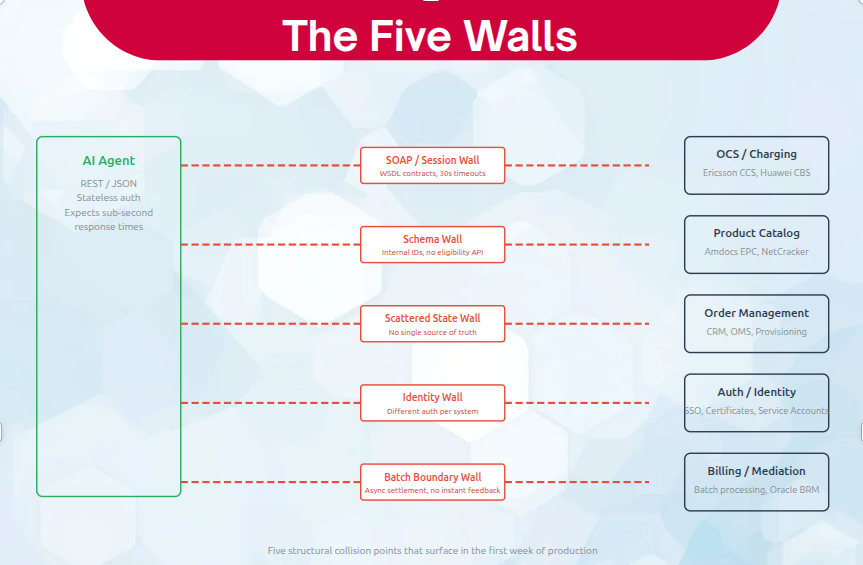
Five specific points where agents collide with BSS architecture. All of them surface within the first week of any production deployment. They are structural, not edge cases.
1. The management API wall
Agentic frameworks are built to call REST endpoints, parse JSON, and use stateless authentication. BSS management APIs were not built that way.
Ericsson Charging, Huawei CBS, and Oracle BRM all expose management interfaces, but the surface looks like enterprise middleware from the early 2010s. SOAP envelopes with WSDL contracts. Session-based authentication where the caller logs in, receives a token, runs a sequence of operations, then logs out. Synchronous calls that translate internally to chains of database queries and inter-system requests, with 30-second timeouts that return generic faults when any link in the chain stalls.
An agent that issues parallel requests, expects sub-second responses, and does not manage session lifecycle will exhaust connection pools, breach concurrency limits, and trigger session lockouts that affect every other consumer of that API. The agent sees opaque failures. The BSS sees a misbehaving client and starts refusing connections. By the time anyone correlates the two, the incident is already open.
(The Diameter signaling plane — Ro, Gy, Sy — is a separate question. Agents do not touch that path. Network elements do.)
2. The product catalog schema problem
Every useful agent workflow eventually asks “what can this customer do,” “what does this product include,” or “is this customer eligible for this offer.” All three depend on the product catalog. None of them map cleanly to the schema the catalog exposes.
Amdocs Enterprise Product Catalog stores products as TM Forum SID-aligned specifications with characteristics, prices, and validity periods. NetCracker models them as service specifications with fulfillment dependencies. Oracle BRM uses a plan/deal/discount hierarchy. None of these expose a native API that answers “is customer X eligible for product Y” without internal references the agent has no way to populate — segment codes, eligibility rule set versions, whether the check should run against the active catalog or the pending one.
The workaround in most pilots is a hand-maintained lookup that translates plan names to internal IDs. This breaks the moment marketing launches a new variant or revises eligibility, because the lookup is now stale and the agent is producing confident, fluent, wrong answers.
3. State scattered across systems
BSS order management is a state machine, but rarely an explicit one. State is inferred from the combination of records in CRM, OMS, billing, and provisioning. CRM exposes a small set of high-level order states. OMS exposes a different set with finer-grained provisioning substates. Billing has its own status values for rating and invoicing readiness. The three systems do not map to each other one-to-one, and they were never designed to.
The agent assumes a clean state machine: order is in state X, agent proposes transition to state Y, system validates and executes. The actual environment has multiple systems each holding part of the truth, and the cases where they disagree are exactly the cases that produce fallout. When the agent sees “Pending Approval” in the CRM, it does not know whether OMS shows the order as awaiting inventory, awaiting credit check, or awaiting upstream provisioning — and the right next action is different in each case.
This is the failure mode behind most order fallout automation that misfires. The agent approves an order that was pending for a reason the agent never queried, because the reason lived in a system the agent was not connected to.
4. Identity and session
This is the wall most pilots underestimate. Each BSS system authenticates differently. CRM is typically tied to corporate SSO with named users and federated identity. The OCS uses service accounts with IP allowlists. Billing requires certificate-based mutual TLS. Mediation systems sit behind VPN tunnels with their own access control. The data warehouse exposes JDBC with database-level credentials.
An agent making a cross-system query needs to authenticate to each system through its own mechanism, manage credential rotation for each, handle token refresh independently, and ensure the audit trail attributes actions to a meaningful identity rather than a shared service account. Across the four or five systems an agent typically touches, credential management becomes larger than the agent logic itself. Most pilots ignore this and run the agent on a single elevated service account, which works in the sandbox and creates a security and audit problem in production.
5. The batch boundary
Charging, mediation, and billing systems were designed around batch reconciliation. Mediation collects CDRs in scheduled windows. CDR processing into rateable events runs on a schedule. Balance updates are applied in batches, not at the moment of the API call. Revenue recognition runs end-of-day or end-of-month.
When an agent takes an action that updates a customer’s financial state — applying a credit, reversing a charge, triggering a promotion — the action is queued. The balance does not change on the next API call. If the agent treats the API response as confirmation that the balance has updated, it makes two kinds of errors. It retries because the balance still shows the old value, queueing duplicate operations. Or it uses the unchanged balance as the basis for a downstream decision — granting an upsell, evaluating eligibility — making the next decision against stale data.
The batch boundary is harder to abstract than the others because it is not a protocol or schema problem. It is an architectural property of the systems themselves, and the abstraction has to model it explicitly rather than hide it.
The abstraction layer
The fix for these walls is not to fix each one in isolation. It is to put an integration abstraction layer between the agent and the BSS, and to make that layer the single contract the agent depends on.
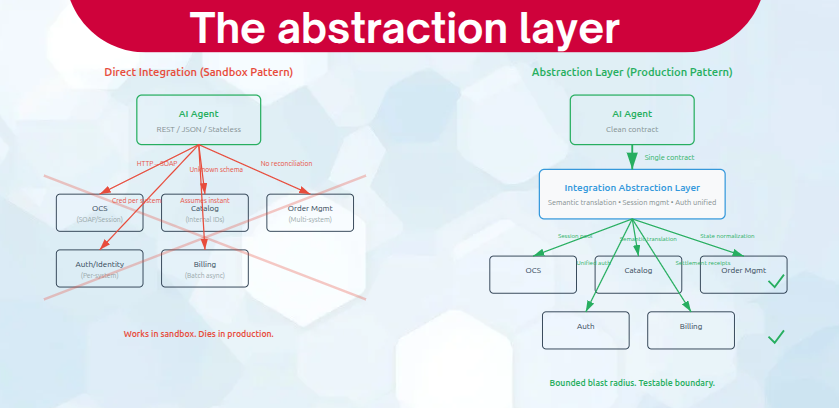
The abstraction is semantic, not a protocol gateway. The agent asks “is this customer eligible for this plan” through a defined operation. The abstraction translates the request into the catalog’s internal query format, executes it in the right sequence against the right catalog version, interprets vendor-specific error codes, and returns a normalised response. The agent never sees SOAP envelopes, never knows the catalog’s internal schema, never handles session login and logout, never reasons about batch timing.
Three properties make the abstraction work. The translation is semantic — the abstraction maps agent intent to the correct sequence of BSS operations, not a one-to-one wrapper around an existing API. Responses are normalised — vendor-specific fault codes that mean the same underlying condition are translated to a common shape. And the abstraction enforces least privilege — the agent can request defined operations and nothing else, regardless of what underlying credentials would permit.
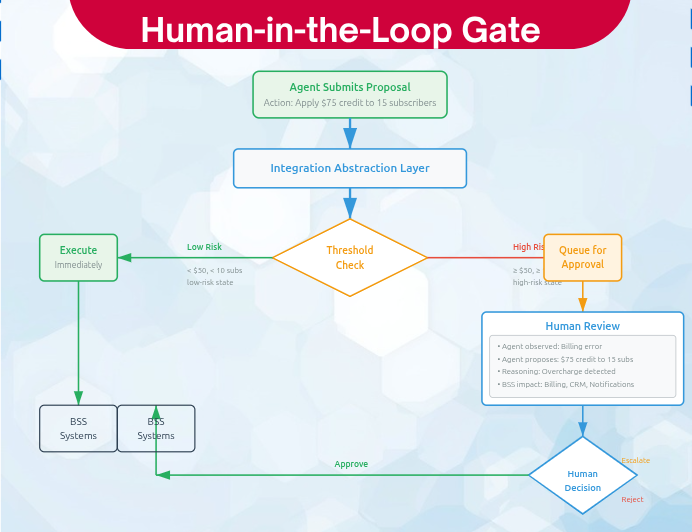
The abstraction is where the human-in-the-loop gate sits. When the agent proposes an action above a defined threshold — a credit above a configured value, an order modification affecting more than a defined number of subscribers, a state transition flagged as high-risk — the abstraction does not execute. It queues the proposal with full context: what the agent observed, what it is proposing, the reasoning chain that led to the proposal, and which BSS systems would be affected. A human reviews and approves, rejects, or escalates. The agent submits and waits for a response. It never sees the approval workflow.
The batch boundary is handled with explicit semantics, not hidden caching. The abstraction returns an action receipt — confirmation that the request has been accepted and queued, not that the balance has changed. Every write carries an idempotency key so retries do not double-apply. For workflows that depend on settlement, the abstraction provides a separate operation to query settlement status, or pushes a settlement event when the batch completes. The agent is told explicitly when to wait, and never given a balance that may or may not be real.
The abstraction is also the security perimeter. Custom integration code that authenticates, translates between systems, and acts on the BSS lives in one place rather than scattered across agent prompts and ad-hoc scripts. Input validation, rate limiting, and anomaly detection happen at the boundary. A misbehaving or compromised agent can issue requests; the abstraction can reject them before they reach the BSS.
What this looks like in practice
The abstraction exposes a small set of operations covering the specific intents the agent needs — typically fifteen to twenty-five for a focused use case. For order fallout: retrieve a fallout ticket, query order state across systems, check product eligibility, get inventory status, propose an order correction, retrieve customer context. Each operation has a defined input schema, output schema, error taxonomy, and retry policy.
Authentication and session management live inside the abstraction. The agent identifies itself once. The abstraction maintains the session pool, certificate trust, and token lifecycle for each downstream system, and attributes every action to a meaningful identity in the audit trail.
The abstraction is where boundary testing happens, before the agent logic exists. The layer is stood up against the actual BSS, integration tests are written against each operation with realistic payloads, and the failure modes surface where they can be fixed cheaply. If check_product_eligibility returns malformed responses for one in fifty queries, or query_order_state takes thirty seconds when OMS is under load, the team learns this from the test harness rather than from production incidents.
What this means for SIs bidding on this work
For an SI responding to an RFP for agentic AI in BSS, the abstraction layer is the line item that separates a realistic bid from one that prices the project as if the boundary problems will not surface until after delivery.
An honest bid scopes the abstraction layer as a separate work package, broken down by BSS component, with integration testing as a milestone before agent logic development begins. The work is owned by integration architects who have actually built against the operator’s BSS stack — not assumed away, not deferred to a discovery phase, not treated as part of the agent’s prompt engineering.
The alternative — wiring the agent directly into BSS APIs and hoping the sandbox patterns hold up in production — works long enough to win the demo and short enough to lose the contract on the first incident.
The fear that AI will wreak havoc in production BSS is not irrational. The systems are old, the data is messy, and the consequences of errors are measured in revenue and churn. But the havoc, when it happens, is almost never because the AI itself is unpredictable. It is because the AI was allowed to touch systems that were never designed to be touched that way, and the boundary between the two was never deliberately architected.
Build the abstraction layer. Make it the contract both sides depend on. Test it against the real BSS before any agent logic exists. The blast radius becomes bounded, and the fear becomes a manageable engineering problem rather than a recurring incident.